Sunscreen Review: Coola

Sunscreen Review: Coola

Coola sunscreen is highly recommended for its skin nourishing ingredients and weightless feel. But only if you're ready to splurge on sunscreen!
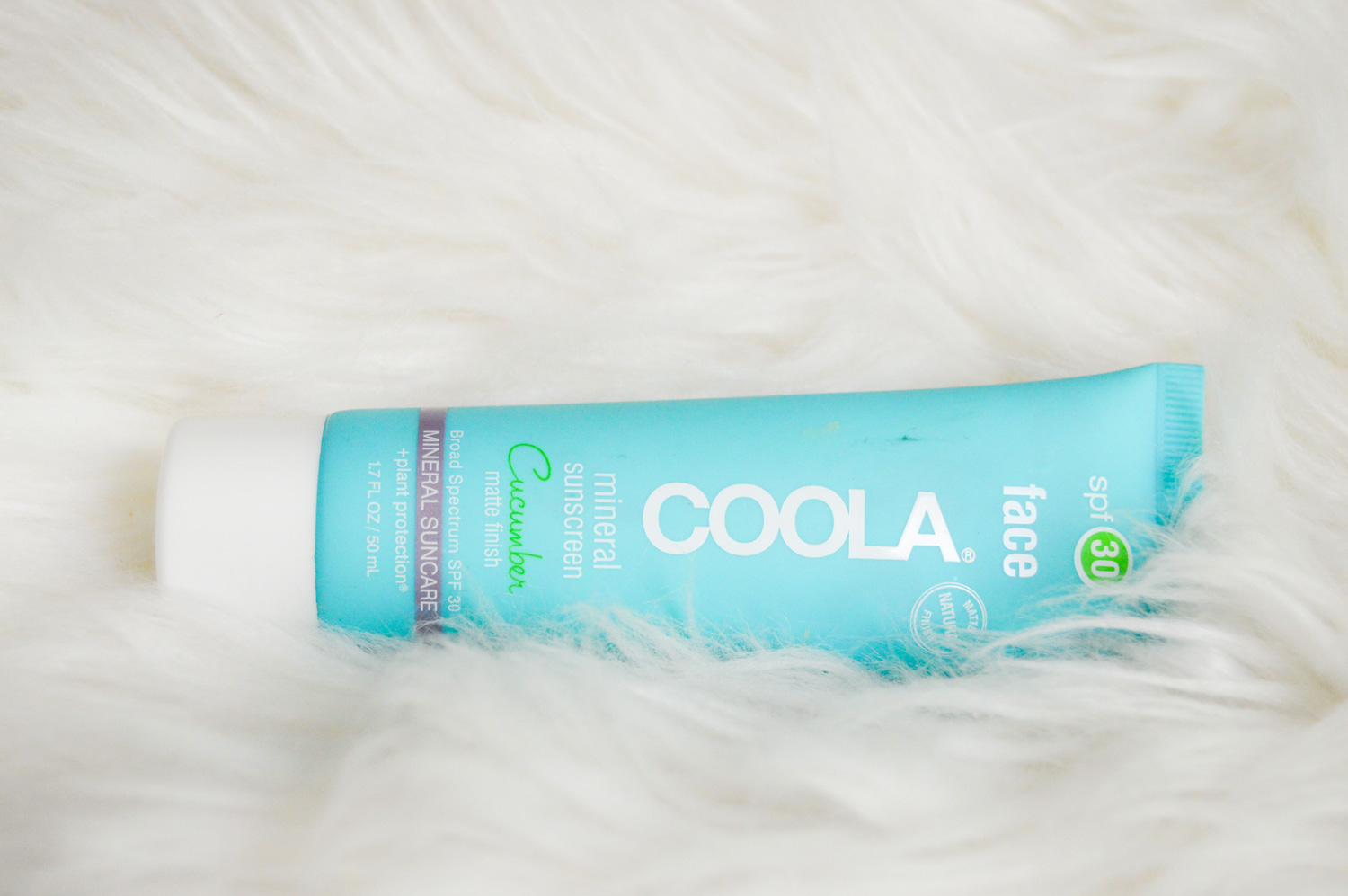
Yes, I broke out my shag rug to take a picture of my beloved (and pricey!) everyday sunscreen. See the smudges on the bottle for proof that this goes everywhere in my purse with me.

This blog post is 100% my own opinion and I have not been compensated monetarily or with any products.

I slather on the sunscreen every day, in every season. If you catch a whiff of some strong, banana boat smell in the middle of a dark and cloudy winter’s day, I’m probably close by.

Since I go through so many tubes of sunscreen, I tend to become obsessed with the ones that work for me. Right now, I’m using Coola sunscreen for daily application to my face. (Yes, I use different sunscreens for face and body).

How to Find the Best Sunscreen

Generally when I find a sunscreen I’m willing to commit to, several factors come into play. My main considerations are weightiness, smell, ingredients, price, skin reaction, and SPF level. Here’s where Coola scores in those sections:

Weightiness

Coola’s lightweight formula is perfect for layering under makeup. Although their site says that the product will reduce shine, I find that it adds a little shine—but in a good way. This is the beauty era of faces glistening with highlighter and hydration, and I find that once I’ve finished putting makeup on, the shine is just enough to glimmer without looking greasy.

Because Coola is lightweight it’s perfect for my everyday sunscreen— it doesn’t look like I’ve glopped on heavy duty sunscreen. But if I’m spending serious time out in the sun on a rare beach trip, I would likely go with something with heavier weight and power.

Smell

I have Coola in the cucumber scent, but I absolutely smell nothing in it. Maybe my nose isn’t sensitive enough, but they also offer an unscented version if you can detect a smell.

Ingredients

The ingredients in Coola sunscreen take it beyond sun protection and into skin nourishment. It also contains rose hip seed oil, which deposits antioxidants into the skin, plankton extract, and shea butter. My skin always feels softer after applying. And there’s no ghostly-white cast that many sunscreens leave. I’m pale enough, thanks.

Recent studies have found that common sunscreen ingredients, like oxybenzone, can disrupt hormone levels and cause issues to reproductive and thyroid systems. You don’t have to worry about what’s in your sunscreen when you use Coola, it avoids all those toxic chemicals.

Price—$$$

Here’s where I get tripped up about Coola. For all its skincare and protection awesomeness, you’re going to have to pay. Its 1.7 fl oz bottle costs $36. For me, that places Coola firmly in the fancy shmancy sunscreen section. Luckily, it spreads well and you don’t have to use a lot to cover your face. A bottle usually lasts me a couple months with daily application. But if I’m tightening my budget, I have to sacrifice the expensive sunscreen and go with my drugstore choices.

Skin Reaction

I’ve noticed that some cheaper sunscreens will leave a burning sensation around my eye area. The last thing I want is to trade a sunburn for some kind of chemical burn. None of that stinging happens when I apply Coola, and I’ve never had any breakout reactions either. It feels nourishing on the skin (as it should, for the price).

SPF Level

Coola’s SPF, or sun protection factor, is at a moderate 30. This makes it ideal for an everyday sunscreen, when I’ll only have limited direct exposure to the sun. If I know I’m going to be camping or hiking, then I’ll opt for a stronger sunscreen, more oriented for outdoor/sweat/sport use.

Overall, if you’re in a sunscreen splurging mood, I definitely recommend Coola. I don’t regret buying it once I’ve been using it for a few days. But when I’m forced to be more frugal, I find that it’s a sunscreen I can live without. Basically, Coola is my sunscreen indulgence.

Check out the Coola website for more information or to purchase!

Spotted Science: What Causes Freckles?

Spotted Science: What Causes Freckles?

What's in a freckle? It's part gene malfunction, part sun exposure, and a dash of the unknown.

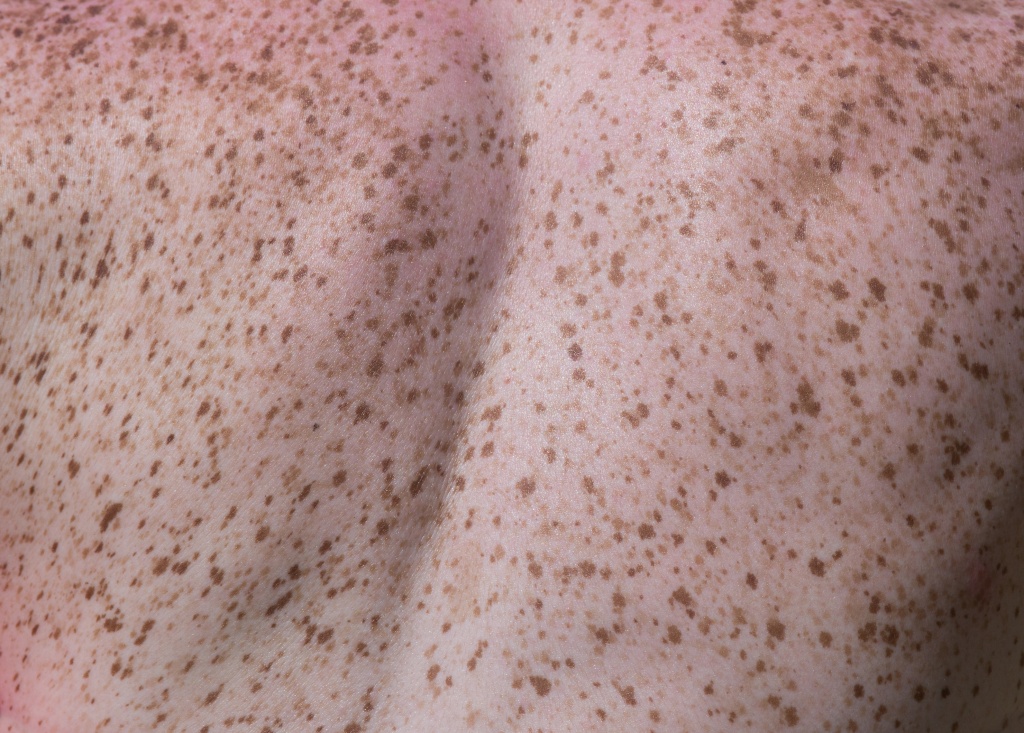
The other day my young nephew was showing me how to play a video game on his handheld device (officially termed a whatchamacallit). I was losing, and maybe he thought I was a lost cause, because he distracted himself by pointing at my arm, where something like 3.5 million freckles are scattered.

“What are these?” he asked.

“Those are just my freckles.”

“Why is your skin like that?”

I mumbled something about lacking melanin and went back to losing at the video game. But his questions made me realize it would do me well to learn the reasons behind my own skin type.

What Are Freckles?

Well, they formally go by ephelides—which comes from the greek word ephelis for concentrated pigmentation. They’re flat, generally brownish in color, and tend to spread like crazy on days when I’ve forgotten my sunblock. There’s not one pointed reason why freckles show up. But if you have the perfect combination of sun exposure and genetics, those dots will likely flare up.

The MC1R Gene Mutation

Every freckle’s origin comes from deep inside, all the way down to the chromosomal level. The MC1R gene is the guidebook your body uses to produce melanin through the melanocortin 1 receptor. Normally this receptor, located on melanocyte, will produce a type of melanin called eumelanin, resulting in an even tan after sun exposure.

But freckles are a different story.

When the receptor is blocked or inactive, it will produce pheomelanin. Pheomelanin is the specific type of melanin responsible for freckles, and usually light hair and eyes too.

The variance in the MC1R Gene that results in freckles means that your speckles can be considered mutations. But if you’re not a fan of X-Men and don’t want to embrace your mutant side, they’re also called polymorphisms or variances in the gene.

Ultraviolet Light

But a freckle isn’t made even if all the genetic factors are in place. Even people with the MC1R gene mutation will never have a single spot if their skin isn’t exposed to ultraviolet light. If this person exists, I want to know what sunscreen they’re using.

Any lifelong freckle face will know that freckles aren’t going to pop up under fluorescent lights or incandescent bulbs. But a few minutes outside sans sunscreen, even on a cloudy day, and most likely you’ll see the freckles start to react. This is because freckles are receptive to ultraviolet light, particularly the stronger UVB waves.

It might seem like the sun is beating down with intense UVB waves to make our skin start to freckle. But really, the sun’s waves are a low dose concentration of UVB rays. Ultraviolet only makes up 10% of the sun’s rays, and of that 95% are UVA, leaving a mere 5% as UVB.

That low concentration of UVB rays can still wreak real havoc to our sensitive, freckly skin. Sunscreen is our savior.

The Mysterious Freckle

It’s an easy equation, MC1R mutation + sun exposure = freckles.

But it gets more complicated. That MC1R malfunction that creates the possibility for freckles also determines things like red hair. However, many people have freckles without the scarlet locks. And red hair is recessive, while freckles are dominant.

All this suggests that there’s more to be learned about the mysterious freckle. There are likely more factors at play than the sun and the MC1R gene when it comes to the dots.

Freckles – A History of Rejection

Freckles – A History of Rejection

Photo by Álefe Almeida on Pexels.com

Modern Criticism of Freckles (Thank You, South Park)

In the U.S. you’d be hard pressed to find a freckled person who hasn’t been taunted by insults popularized by the Comedy Central TV show South Park. In the episode, people with red hair and freckles are referred to as gingers, and people with pale skin, but no freckles, are called daywalkers.

But they don’t stop at nicknames, anyone who is redheaded and freckled in the episode is thought to have a disease called Gingervitus, and are treated as inferior to everyone else. Here are some memorable quotes from the episode:

“Make no mistake! Ginger kids ARE evil. Do you know who was Ginger? Judas.” – Cartman

“Your son will be Ginger his whole life. You might want to just . . . put him down.” – Dr. Doctor

“We’ve all seen them. On the playground, at the store, walking on the streets. They creep us out and make us feel sick to our stomachs.” – Cartman

Rooted in Classism

But South Park isn’t the first to advance the mockery of freckles, far from it. What’s portrayed as a joke now (albeit one that can go too far) started as a way to distinguish among the classes. Freckles once literally marked who the low class were in U.S. and European societies.

Before the 1900s to around 1910, porcelain skin was the beauty trend everyone wanted. Tanned or freckled skin indicated that a person was a laborer, had to work outside for money, and was therefore an inferior class to the wealthy elite, who stayed indoors and could afford topical treatments that lightened their skin. The staunch racism of the time period against more melanated people also made pale skin a desirable trait for this society.

As early as the 1900s, the LA Times was publishing advertisements for lightening creams that promised to erase freckles and turn the skin white.

How Far Have We Come?

In 2019, the desire to remove freckles has produced a whole beauty skin care line of topical treatments from companies like Clinique, Murad, and La Mer. However, we can see attitudes shifting toward the desire to have a more unique skin complexion, as beauty influencers have started mimicking the freckle look by applying the dots to their face with makeup. Keep in mind, this mostly applies to attitudes toward freckles on females.

In the UK, Gingerism appears to be alive and well today. In 2010, anti-ginger ads were published in the nation’s newspapers, and later removed after the outcry. The hateful attitudes against freckles and redheads may be felt more potently across the pond, because of the fraught history between Britain and Ireland.

Lisa Wade, associate professor of sociology at Occidental College, emphasizes that males with freckles get the worst of any kind of freckled discrimination. “Men and boys appear to be more frequent targets than women and girls, who at least are sometimes seen as uniquely beautiful.”

Freckling Forward

Freckled skin is best paired with thick skin. The comments used to get to me. Obviously, bullying, teasing, and insulting tends to make a person feel bad. After the millionth time hearing, “Oh, you have no soul!” my go to response became, “How original! You must be so smart to come up with that all on your own.” It usually shut people up.

Eventually I developed a thicker skin and any ginger related nicknames roll right off of me. Nobody can make me feel bad about my freckles anymore.

Do you know some freckled history? Or have a clever way to deal with the taunting? Share it with me in the comments or email freckledtheblog@gmail.com

What Else Are Freckles Called?

What Else Are Freckles Called?

Photo by Milena Santos on Pexels.com

When I was five years old, I happened to be a ginger living in the Pacific Islands, and my freckles were ablaze. One day I stood at the check out line of the local general store holding a prized beanie baby I wanted to buy with my allowance money (like any respectable 90s kid).

The lady ahead of me in line turned and immediately started cooing over my freckles. She told me I was beautiful, and that each freckle represented an angel kiss. I felt special, standing in that line with seemingly millions of angel kisses on my skin.

The tone of reaction to my freckles took a hard turn in middle and high school. I started hearing my spots referred to as “shit through a screen door,” or that each one was a stolen soul. I felt less than special. The way society refers to freckles is just another example of the harsh dichotomy that comes with living speckled.

Here’s a round up of the many names—some affectionate, some less so—that freckles go by.

  • Freckled
  • Speckled
  • Dots
  • Spots
  • Ink Blots
  • Constellations
  • Shit through a Screen Door
  • Sun Kisses
  • Angel Kisses
  • Daywalker
  • Stolen Souls
  • Ruddy Faced
  • Epelides

Some of these aren’t so nice, but no matter what you call them, freckles are nothing more than a concentration of melanin. It’s up to you what meaning you place in your dots.

Did people give you a unique name because of your freckles? Maybe you have your own name for your freckles. I want to hear your freckly nicknames! Drop me an email at freckledtheblog@gmail.com or comment below.

Tomorrow I’ll be posting about the historical background in Europe and the United States that explains the negative attitudes toward freckles, which have survived to this day! It’ll shed some light on why there tends to be more insults than compliments when referring to freckles. Until then, be kind to yourself and your freckles!

Welcome to Freckled!

Welcome to Freckled!

Photo by Matheus Bertelli on Pexels.com

Freckled is a community of empowerment for the spotted and dotted among us. From mockery to emulation, freckles tend to elicit a strong response. This is a place where we can explore those experiences of rejection, as well as provide informed, research-driven information on the best way to care for those little dots. Above all, we want you to feel comfortable in your own, unique skin.

The Freckled Founder

My name is Madelyn, and I’m a lifelong freckle-haver. I distinctly remember being labeled the “ugly girl” in my Kindergarten class because of the marks on my skin. Being told you’re ugly at a young age easily becomes internalized and manifests well into adulthood.

Once I was in high school, it seemed over night I was receiving a different kind of attention, one that hypersexualized me based on my hair color and freckles. For a majority of my life, I wished my freckles away, and even had applied some DIY topical treatments to make them disappear. Not a single freckle vanished. In fact, they just seemed to accumulate with the passing years. Today, I’m thankful I failed.

The Freckled Mission

Whatever the response, freckled people stick out and tend to invoke strong reactions, from bullying to fetishizing. The Freckled blog thoughtfully examines those interactions, hopefully making us feel more like a group of people and less like a human spectacle. It’s a community where we can break down myths and misconceptions, and learn about the power and precautions that come with having freckles.

Freckled intends to create a space where people of this complexion can relate to the unique difficulties that come with being speckled, from health concerns to bullying.

Of course, the more melanin blessed are welcome to learn more about freckles here as well!

Alright, if you’ve made it this far, I have one request. I want to know more about your experience with freckles. How did you struggle with them? How did you celebrate them? Do they hold you back – from clothes, or going on vacations, visiting certain sunshine-intense parts of the world? I’m always looking for sunscreen recommendations too. This blog is for you, so drop me a comment or email freckledtheblog@gmail.com. I promise I read and respond to every note.

In the mean time, slather on the sunscreen and read on!